
History of the Giants of the North: origins, traditions and heritage of the Hauts-de-France
Discover their history, how they are made, their role in carnivals and traditional festivals, and the most famous Giants of France and Belgium. Present at carnivals, ducasses, patronal festivals and major parades, these impressive processional figures have brought life to towns and villages for centuries.
Crafted using traditional skills that combine wickerwork, wood, sculpture, sewing and painting, the Giants represent historical figures, legendary heroes, traditional trades or popular characters closely associated with their hometown. Far more than simple parade figures, they embody the identity, collective memory and living heritage of the communities that keep them alive.
Today, the processional Giants continue to attract thousands of visitors to major traditional festivals. Carried by volunteers and accompanied by concert bands, fanfares and folk groups, they perpetuate a centuries-old tradition that remains one of the symbols of the heritage of Hauts-de-France and Belgium.
Part of this tradition has received international recognition through the inscription of the Processional Giants and Dragons of Belgium and France on UNESCO's Representative List of the Intangible Cultural Heritage of Humanity. In France, several events dedicated to the Giants are also included in the National Inventory of Intangible Cultural Heritage.
The Giants of the North: a living heritage of the Hauts-de-France
Processional Giants play an essential role in the popular traditions of northern France and Belgium. Each town or village gives its Giants a unique identity, inspired by its history, legends, traditional trades or the people who have shaped its collective memory.
Their appearance during carnivals, ducasses and patronal festivals is always a particularly anticipated event. These gatherings bring together several generations around a living heritage where music, folklore, craftsmanship and community spirit come together.
Today, local associations, bearers, craftsmen, musicians and volunteers continue to ensure the creation, maintenance and transmission of this tradition. Thanks to their dedication, the Giants continue to enliven the major traditional festivals of northern France and Belgium, preserving a living heritage that is recognised far beyond their regions of origin.
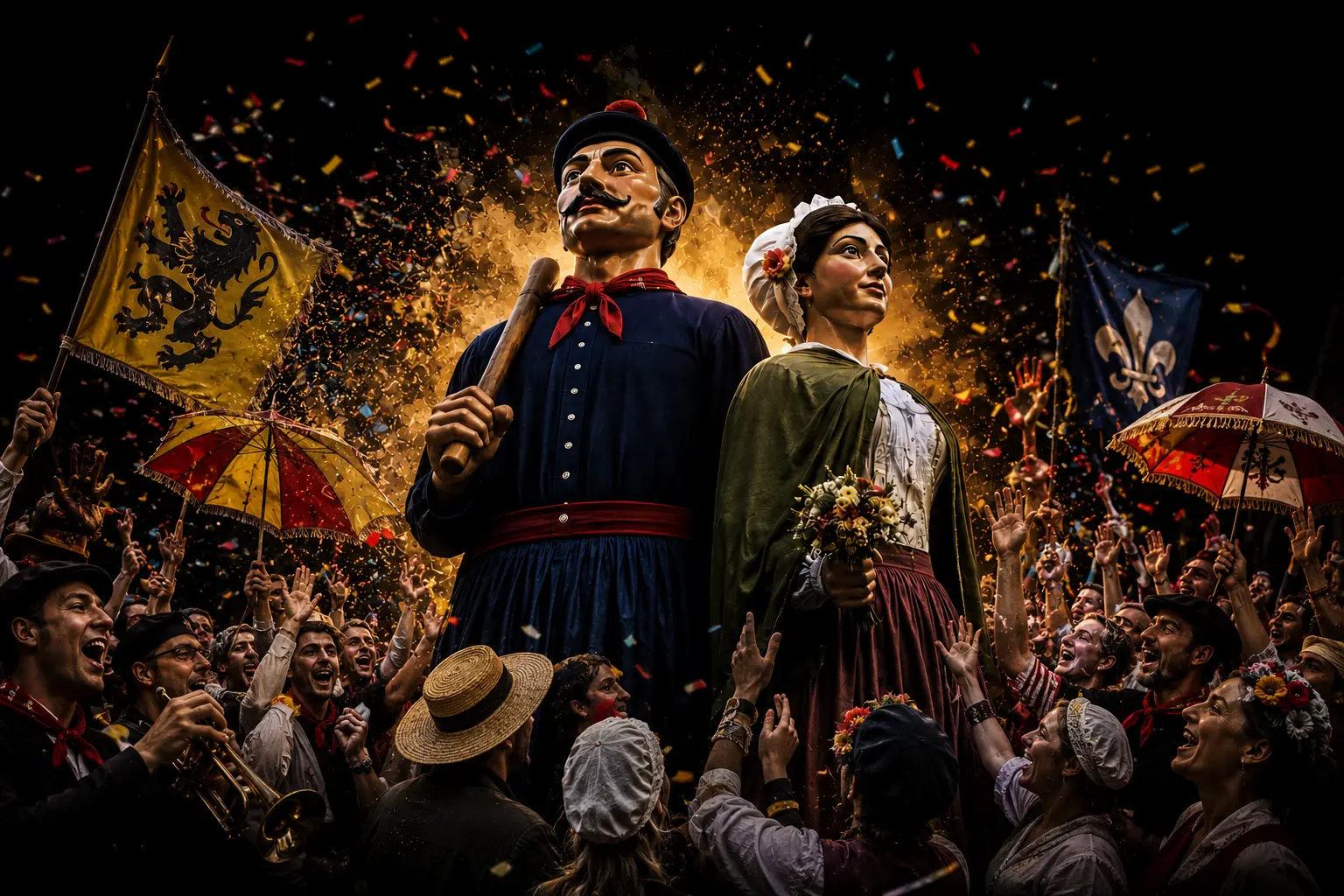
The Giants of the North, symbols of the cultural heritage of the Hauts-de-France region, have been at the heart of the festivals and folk processions that have enlivened French Flanders for several generations.
What is the origin of the processional giants?
The first processional Giants appeared at the end of the 14th century on the Iberian Peninsula, particularly in Portugal and Spain, where they took part in the great religious processions held for the Feast of Corpus Christi. They originally represented biblical figures, saints, legendary heroes and mythical creatures, illustrating religious stories and making ceremonies more accessible to the public.
During the 15th century, this tradition gradually spread to the former Low Countries, especially Flanders and Brabant. From the 16th century onwards, processional Giants became established in the towns of Flanders, Artois and Hainaut, territories that are now divided between Belgium and northern France. Initially associated with religious processions, they gradually became part of ducasses (traditional fairs), carnivals and other popular festivals.
Over the centuries, every town and village created its own Giant, inspired by a historical figure, a local legend, a traditional occupation or a well-known local character. Little by little, these impressive figures became symbols of their communities and came to occupy an essential place in local life.
The Giants, Symbols of the Towns and Villages of Northern France
Each Giant has its own history and remains closely linked to the town or village where it was created. Some honour historical figures, while others represent local legends, traditional occupations, long-standing activities or significant events in local history.
Far more than simple parade figures, processional Giants take part in carnivals, ducasses (traditional fairs), patron saint festivals and major public celebrations. Their appearance in the streets is often one of the most eagerly awaited moments of the festivities.
In the Hauts-de-France region, several Giants have become famous, including Reuze Papa and Reuze Maman in Cassel, the Gayant family in Douai, Binbin of Valenciennes, and the Giants of Bergues, Bailleul, Hazebrouck and Steenvoorde. In Belgium, the Giants of Ath, Geraardsbergen (Grammont), Mechelen and Mons also reflect the richness of this tradition. Today, hundreds of other towns and villages have their own Giant, each with its own history, name and traditions.
Beyond their role in popular celebrations, the Giants help preserve local memory. They reflect the roots of a region and contribute to passing on a cultural heritage that continues to evolve while remaining faithful to its history.
How are the Giants of Northern France made?
The creation of a Giant from Northern France requires the expertise of several traditional crafts and skills that have been passed down for generations. Each Giant is unique and requires many hours of work to produce a structure that is both strong, lightweight and perfectly suited for parades.
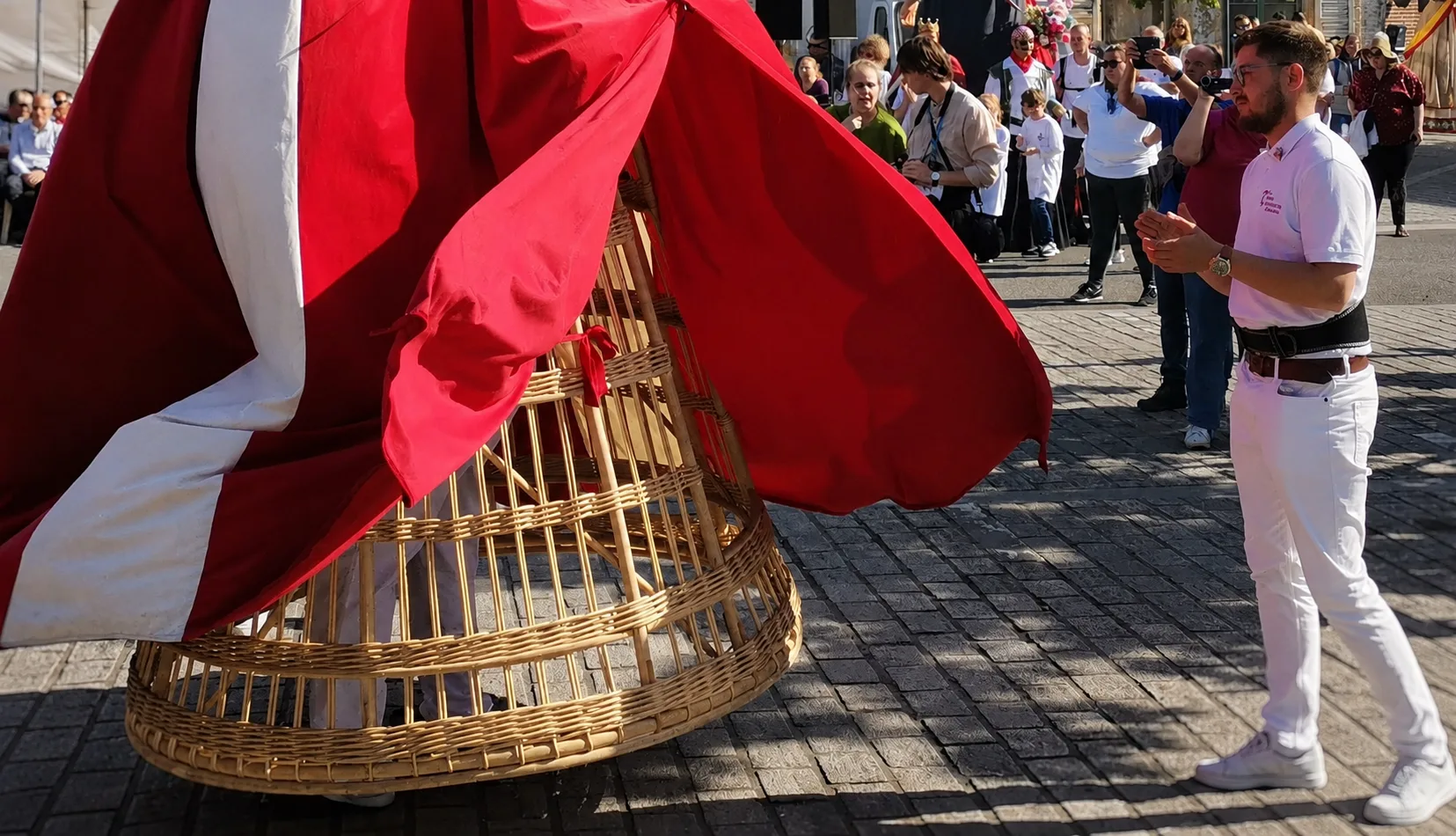
The framework is generally made of wood, aluminium and woven wicker. Traditionally used in basket weaving, wicker is highly valued for its flexibility, strength and light weight. It makes it possible to create large figures while ensuring they can be carried during carnivals, ducasses (traditional fairs) and popular festivals.
The head, hands and sometimes decorative elements are first sculpted before being reproduced in lightweight materials such as papier-mâché, plaster or resin. Every detail is carefully crafted to give each Giant its own expression, personality and identity.
The costume is then made to measure. It is inspired by the character being represented, whether a historical figure, a legendary character, a craftsman, a farmer or a well-known local personality. The fabrics, colours and accessories help make every Giant instantly recognisable.
Depending on their size, Giants can stand between 3 and more than 8 metres tall. Their weight varies according to the materials and construction, while remaining suitable for carrying during parades.
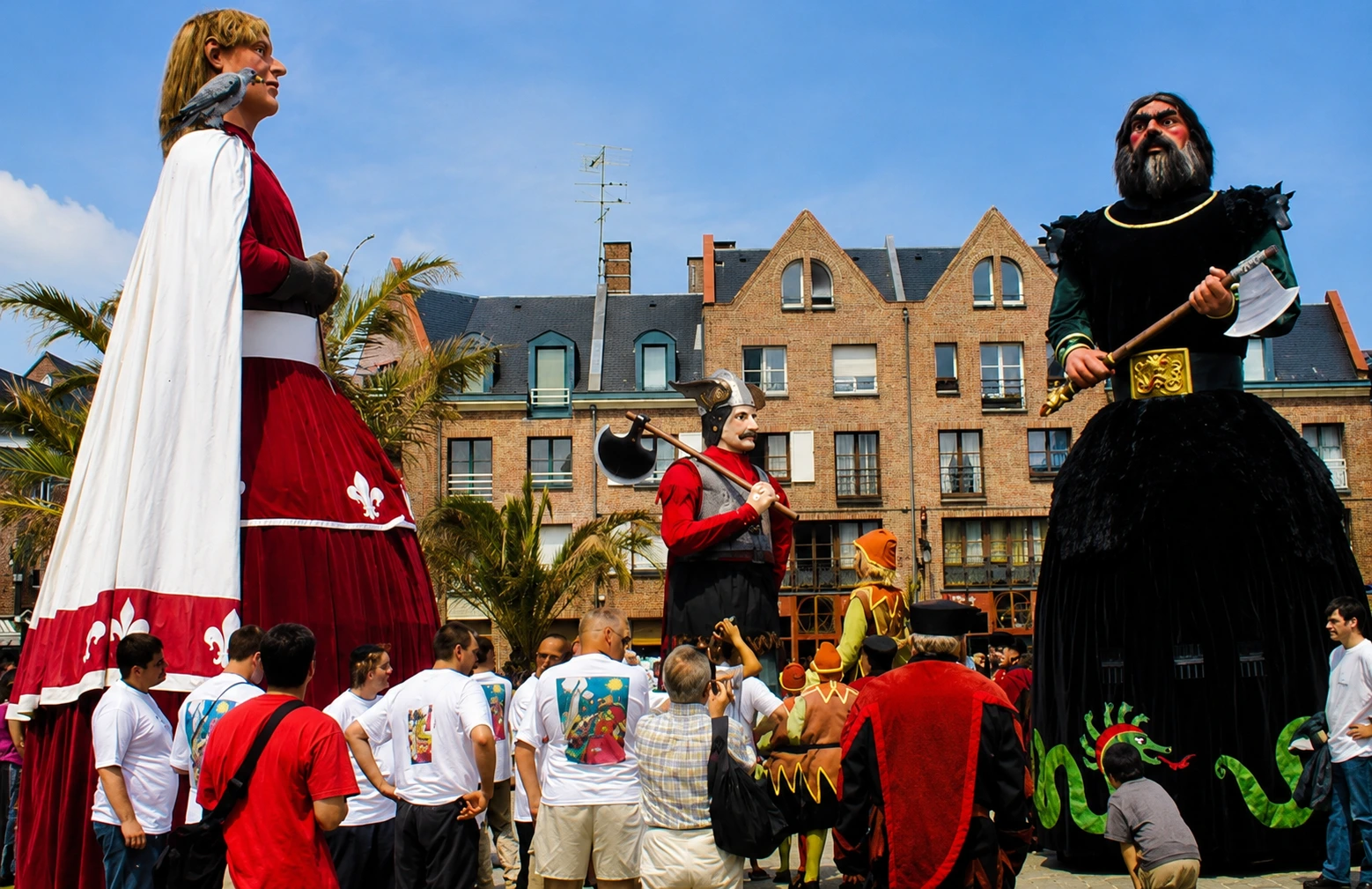
Photograph taken during the grand gathering of giants held in Lille in 2005 on the forecourt of Notre-Dame-de-la-Treille Cathedral. Several traditional and carried giants from northern France and Flanders gathered before the public, showcasing the region’s rich festive heritage and folk traditions.
The Bearers Bring the Giants to Life
A processional Giant truly comes to life only when it is carried. Inside the structure, the bearer maintains its balance, guides its movements and gives it life through precise and carefully controlled motions.
To the sound of concert bands, brass bands and folk groups, the Giant walks through the streets, greets the crowd, turns gracefully or even performs dance steps. This performance requires experience, good physical fitness and a thorough understanding of the character being portrayed.
Depending on their size, some Giants are carried by a single person, while the largest require several bearers or specially designed carrying systems. Local associations regularly organise training sessions to pass on these techniques and ensure the continuity of this tradition.
Every appearance is the result of a collective effort. In addition to carrying the Giants, volunteers maintain the structures, restore the costumes, prepare the parades and organise the events to which the Giants are invited.
The Giants in the Carnivals and Popular Festivals of Hauts-de-France
It is impossible to talk about processional Giants without mentioning the carnivals, ducasses (traditional fairs) and popular festivals that have shaped life in the Hauts-de-France region for centuries. These events bring together residents and visitors around festive traditions deeply rooted in the region's history.
The Giants play a central role in many of the region's best-known celebrations. They take part in the Fêtes de Gayant in Douai, the Dunkirk Carnival, the annual outing of Reuze Papa and Reuze Maman in Cassel, the Steenvoorde Carnival, and the parades of Bergues, Bailleul, Hazebrouck, Wormhout, Armentières and many other towns across French Flanders.
Accompanied by concert bands, brass bands, folk groups and their bearers, the Giants parade through the streets in an atmosphere filled with music, traditional costumes, folklore and community spirit. Each procession highlights the unique identity of the host town while showcasing the richness of the region's cultural heritage.
Beyond the major local festivals, the Giants also take part in regional, national and international gatherings. These events allow associations to exchange expertise, present their creations and introduce the public to the diversity of processional traditions.
Even today, every appearance of a Giant is a highly anticipated event for local communities. It brings together several generations around a shared heritage and helps keep the popular traditions of Hauts-de-France alive.
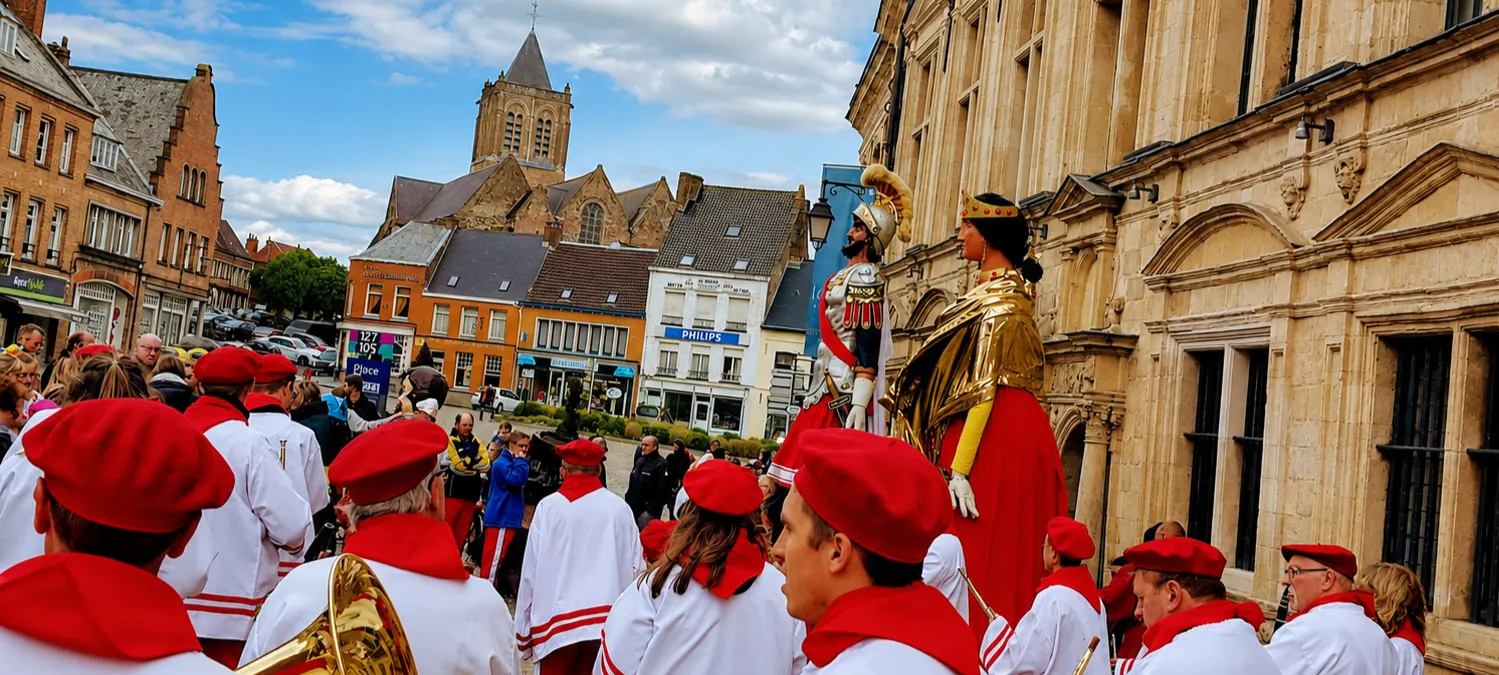
On 19 June 2018, during the filming of the programme *Le Village préféré des Français*, Reuze Papa and Reuze Maman paraded past the Hôtel de la Noble Cour in Cassel. As true symbols of Flemish folklore, they embody the tradition of processional Giants and Dragons, which is inscribed on UNESCO’s List of Intangible Cultural Heritage.
Major Gatherings of Giants
Since the second half of the 20th century, Giant gatherings have experienced remarkable growth. Today, several hundred Giants can take part in a single procession, offering visitors an exceptional spectacle.
These events bring together Giants from the Hauts-de-France region, Belgium, the Netherlands, Spain and sometimes other European countries. They encourage exchanges between associations, showcase different traditions and strengthen the ties between the regions that share this unique processional culture.
For visitors, these gatherings provide a unique opportunity to admire a wide variety of characters, costumes, construction techniques and carrying styles. They also demonstrate the vitality of a tradition that continues to evolve while remaining faithful to its origins.
The Giants of France and Belgium Listed as UNESCO Intangible Cultural Heritage
The rich traditions associated with the Processional Giants enjoy international recognition.
In 2005, the Processional Giants and Dragons of Belgium and France were proclaimed by UNESCO as a Masterpiece of the Oral and Intangible Heritage of Humanity. When the Representative List of the Intangible Cultural Heritage of Humanity was established in 2008, this recognition was officially incorporated into the list.
The inscription notably includes the Giants of Douai, Cassel, Tarascon and Pézenas in France, as well as those of Dendermonde, Mechelen (Malines), Mons and Brussels in Belgium.
This international recognition highlights the importance of the Processional Giants in preserving Europe's popular traditions and passing them on to future generations. It also recognises the commitment of associations, craftsmen, bearers, musicians and volunteers, whose daily efforts help preserve, transmit and keep this intangible cultural heritage alive.
Processional Giants Today
Like many popular traditions, processional Giants experienced periods of decline during the 20th century. Changes in lifestyles, the disappearance of certain local festivals and the consequences of wars sometimes weakened this tradition in many towns and villages.
Over the past few decades, however, the Giants have enjoyed a remarkable revival. Numerous associations are working to restore historic Giants, create new characters, train young bearers and introduce this tradition to an ever-growing audience.
The techniques used to build Giants also continue to evolve. While modern materials often provide greater lightness and durability, craftsmen remain committed to preserving the traditional methods that give processional Giants their authenticity.
Today, the Giants remain ambassadors of a living heritage that brings together history, craftsmanship, music and popular traditions. Their presence at carnivals, ducasses (traditional fairs) and major processions helps preserve a strong cultural identity and pass on a rich heritage to future generations throughout Hauts-de-France, Belgium and the other regions where this tradition continues to thrive.
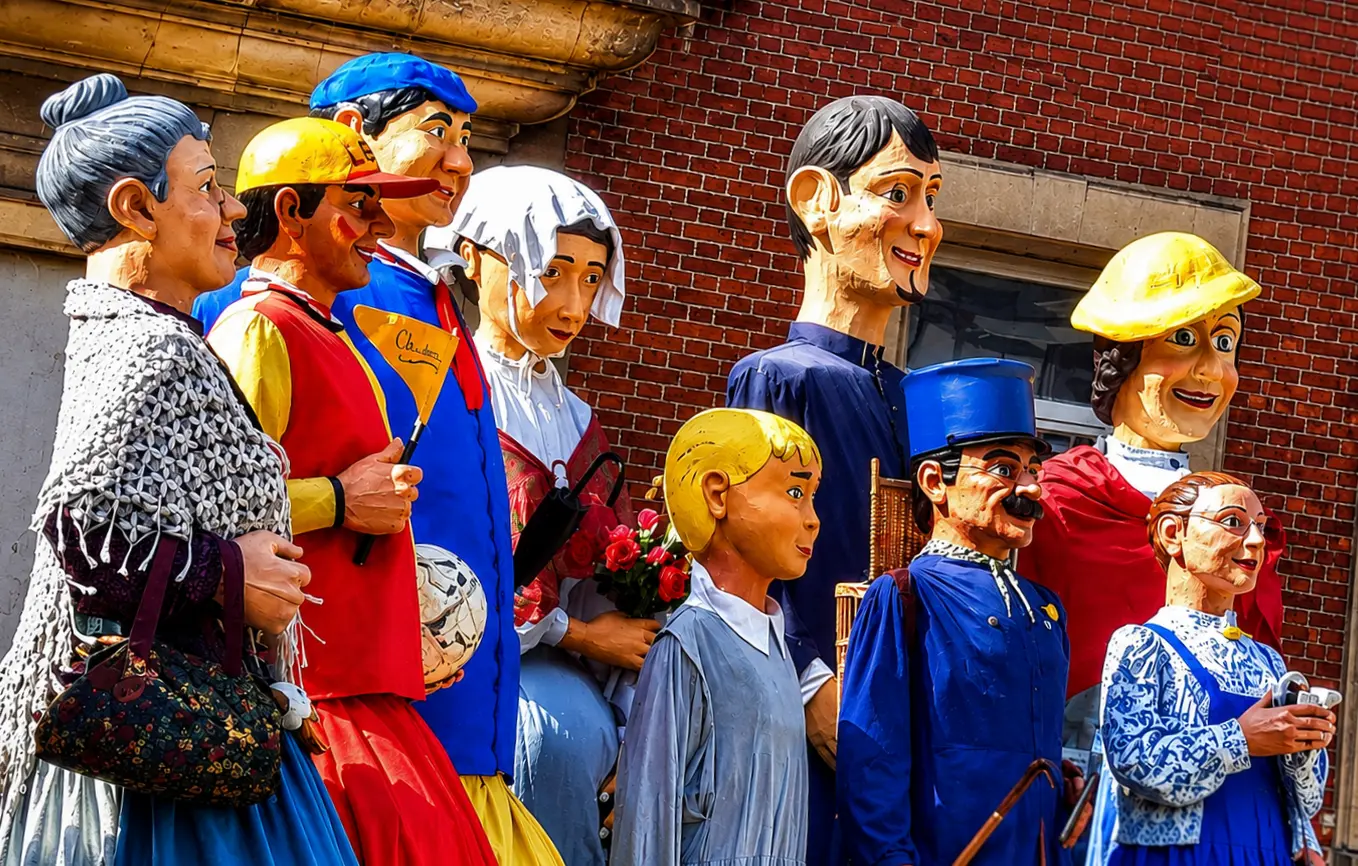
Frequently Asked Questions about the Giants of Northern France
What is the origin of the Giants of Northern France?
Processional Giants originated at the end of the 14th century on the Iberian Peninsula before gradually spreading to the former Low Countries. From the 16th century onwards, the tradition flourished in Flanders, Artois and Hainaut.
Why are the Giants so tall?
Their impressive size originally allowed them to be seen during religious processions and large public parades. Today, their height still enhances the spectacular nature of popular festivals.
How are processional Giants made?
They are handcrafted using traditional techniques that combine basket weaving, woodworking, sculpture, sewing and painting. Their framework is generally made of wood, aluminium and woven wicker.
Who carries the Giants?
The Giants are carried by specially trained volunteers. Depending on their size and weight, they may be carried by a single person or require several bearers.
Continue Your Discovery
Processional Giants play an important role in the folk traditions of French Flanders. To learn more about their history and discover the major events dedicated to them, continue exploring the other pages of this website.
Discover the Giants of Steenvoorde and their history.
Explore the main carnivals and the emblematic Giants of the Heart of Flanders, from Cassel to Hazebrouck, from Bailleul to Steenvoorde, and discover the major festivals that keep Flemish traditions alive.
Learn about the history of the Steenvoorde Carnival and its evolution from the Mid-Lent celebrations.
Discover Steenvoorde, its heritage and its Flemish traditions.

A website dedicated to the Giants of Steenvoorde, their history, their associations and the Summer Carnival.
© 2023 / 2026 – Steenvoorde and its Giants
Legal notices: Website hosted by planethoster.fr
Design: Pascal Cnockaert
Documentation and archives
The information presented on this website is based on public archives, historical publications, press articles, photographic collections, oral accounts and heritage resources relating to the history of Steenvoorde, its giants and its carnival.
Traduction automatique Deepl