
History of Steenvoorde: over a thousand years of history in French Flanders
In the heart of French Flanders, Steenvoorde boasts a rich history stretching back over a thousand years. Founded around a ‘stone ford’ – from which it takes its name – the town developed through trade, craftsmanship and agriculture, situated at the crossroads of the major Flemish trade routes.
From the Middle Ages to the French Revolution, via the Iconoclastic Fury of 1566, the Wars of Religion and the two world wars, Steenvoorde has witnessed the major milestones in the history of Flanders. From medieval lords to Flemish windmills, from the ‘Petit Train des Flandres’ to the rise of the agri-food industry, each era has left its mark on the area.
Even today, its heritage, monuments, paraded giants and Flemish traditions bear witness to this exceptional history. Discover the key events that have shaped Steenvoorde’s identity over the centuries.
An old map of Steenvoorde from Antonius Sanderus’s *Flandria Illustrata* (1641). This engraving is one of the oldest known depictions of Steenvoorde and provides a valuable insight into the town’s layout in the 17th century.
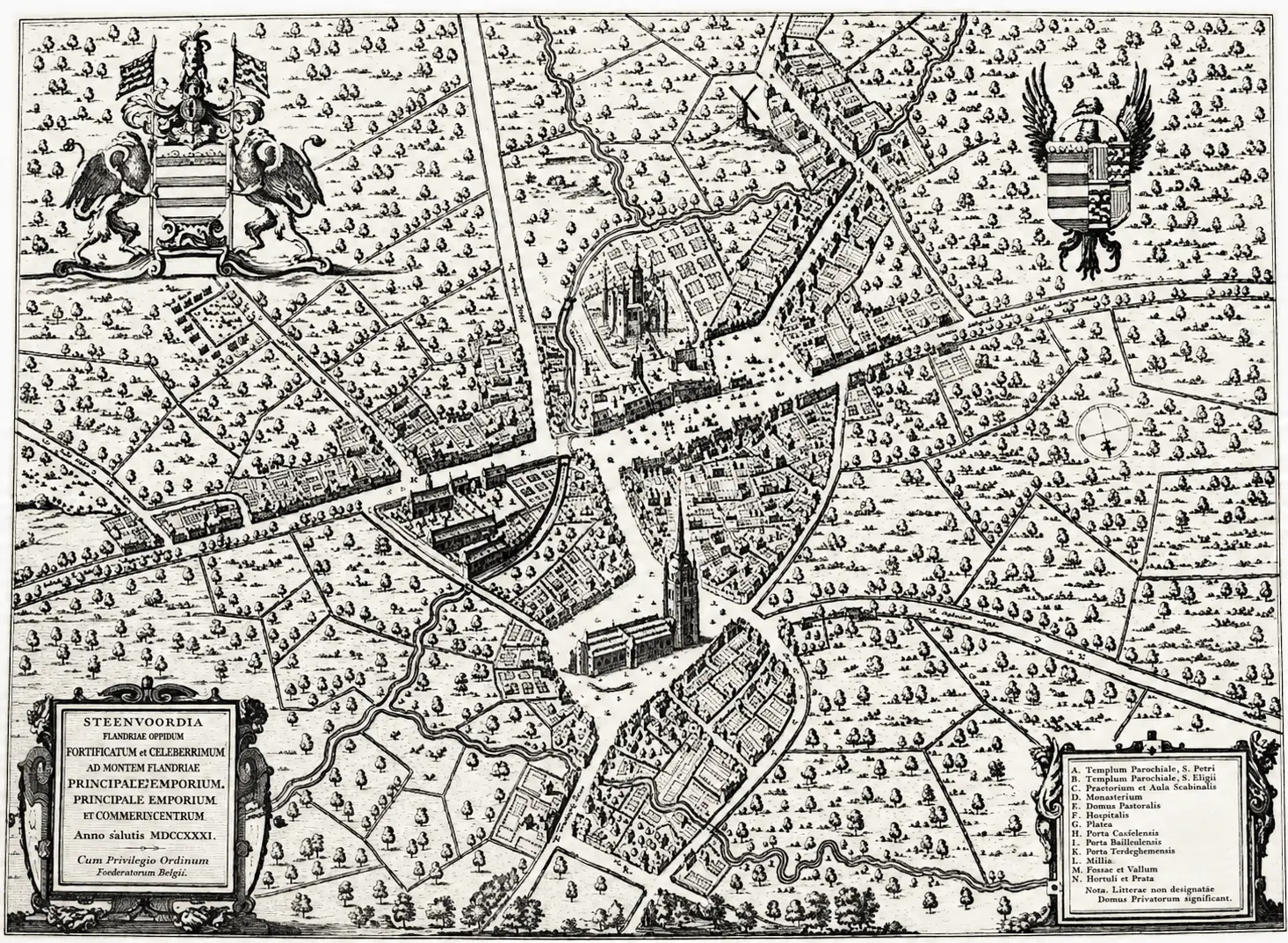
Produced in 1641 and published in Antonius Sanderus’s famous *Flandria Illustrata*, this bird’s-eye view of Steenvoorde is one of the most valuable records of the town in the 17th century. It provides a detailed depiction of the market town, its urban layout and its rural surroundings in the heart of French Flanders.
At the centre of the engraving stands the Grand-Place, around which the main streets of Steenvoorde are arranged. The most notable buildings of the period can also be seen, notably the parish church, the castle surrounded by its moats, the hospice, the convent and a windmill, an iconic symbol of the Flemish landscape. The farmland, carefully divided into plots around the town, illustrates the importance of agriculture to the economy of inland Flanders in the 17th century.
The origins of Steenvoorde
The name Steenvoorde appears in medieval sources in various forms, including Steinforth, Stenfort, Stanfort and Estanfort. Of Flemish origin, it generally means ‘stone ford’, from steen (‘stone’) and voorde (‘ford’), referring to the stone-paved crossing that allowed people to cross the Ey Becque. Situated on an ancient trade route linking Boulogne-sur-Mer to Cassel and then on to Bavay, the town benefited from an advantageous position for trade and travel across Flanders from very early on. The presence of this ford contributed to its development and its integration into the region’s economic networks. At that time, Steenvoorde belonged to the County of Flanders, one of the most prosperous principalities in Western Europe during the Middle Ages.
Among the earliest known lords of the town was Frumold de Steinfort, sometimes referred to in historical sources by the Latin form Frumoldus and known in local tradition as Fromulus. Mentioned at the beginning of the 12th century, he is one of the first figures definitively associated with the seigneurial history of Steenvoorde. A few years later, Guido of Steenvoorde appears in the chronicles relating to the crisis that followed the assassination of Count Charles the Good in 1127. Implicated in the plot behind this murder, he was arrested during the ensuing crackdown and executed that same year. These early references bear witness to the long history of settlement at the site and to Steenvoorde’s early integration into the political and feudal networks of medieval Flanders.
A land of trade and craftsmanship
In the Middle Ages, the local economy relied mainly on agriculture and textiles. Like many Flemish towns, Steenvoorde played a part in the boom of the cloth industry, which brought wealth to the region. In particular, a fabric known as ‘esteinfort’ was produced and marketed under the town’s name. Markets, fairs and trade with neighbouring towns fostered the area’s economic development. Around the market town, farms, craft workshops and activities related to the processing of agricultural produce gradually sprang up.
1214 – Steenvoorde in Philip Augustus's Campaign
At the beginning of 1214, during the campaign led by Philip Augustus against Ferdinand of Portugal, Count of Flanders, Steenvoorde was captured by Prince Louis, the future Louis VIII. This account reflects the importance of the town as early as the beginning of the 13th century. Its location on a route linking Artois with the heart of the County of Flanders gave it strategic importance.
The founding of the Convent of Notre-Dame-des-Sept-Fontaines
The history of Les Sept-Fontaines dates back to the early 15th century. In 1404, Mathieu de Licques, Lord of Steenvoorde, founded the Hospital of Notre-Dame des Sept-Fontaines and entrusted it to a community of Augustinian nuns. The establishment took in the sick, pilgrims and the destitute. According to local tradition, its name refers to the presence of springs or wells on the estate.
Following a fire, the convent and hospital were rebuilt in 1434 with the support of Philip the Good, Duke of Burgundy.
A further reconstruction programme took place in the 18th century, as evidenced by the dates 1734 and 1736 engraved on the buildings of the former hospice.
For more than six centuries, the site remained a place of welcome, care and solidarity. Having become a hospice and then a retirement home, it supported several generations of residents from Steenvoorde and the surrounding area.
Among the nuns who lived at the Sept-Fontaines convent was a figure with an illustrious connection: the sister of the famous Dunkirk privateer Jean Bart took the habit as a regular canoness of Saint Augustine there at the age of 21, under the priory of Marie-Anne De Carnin.
In the 1960s, the former hospice was gradually replaced by a modern care home, which opened in the early 1970s. Following the transfer of residents to a new facility, this building was in turn demolished in 2023.
In 2025, the Sept-Fontaines site regained a central role in the life of the town with the opening of a new market hall dedicated to markets, events and community gatherings.
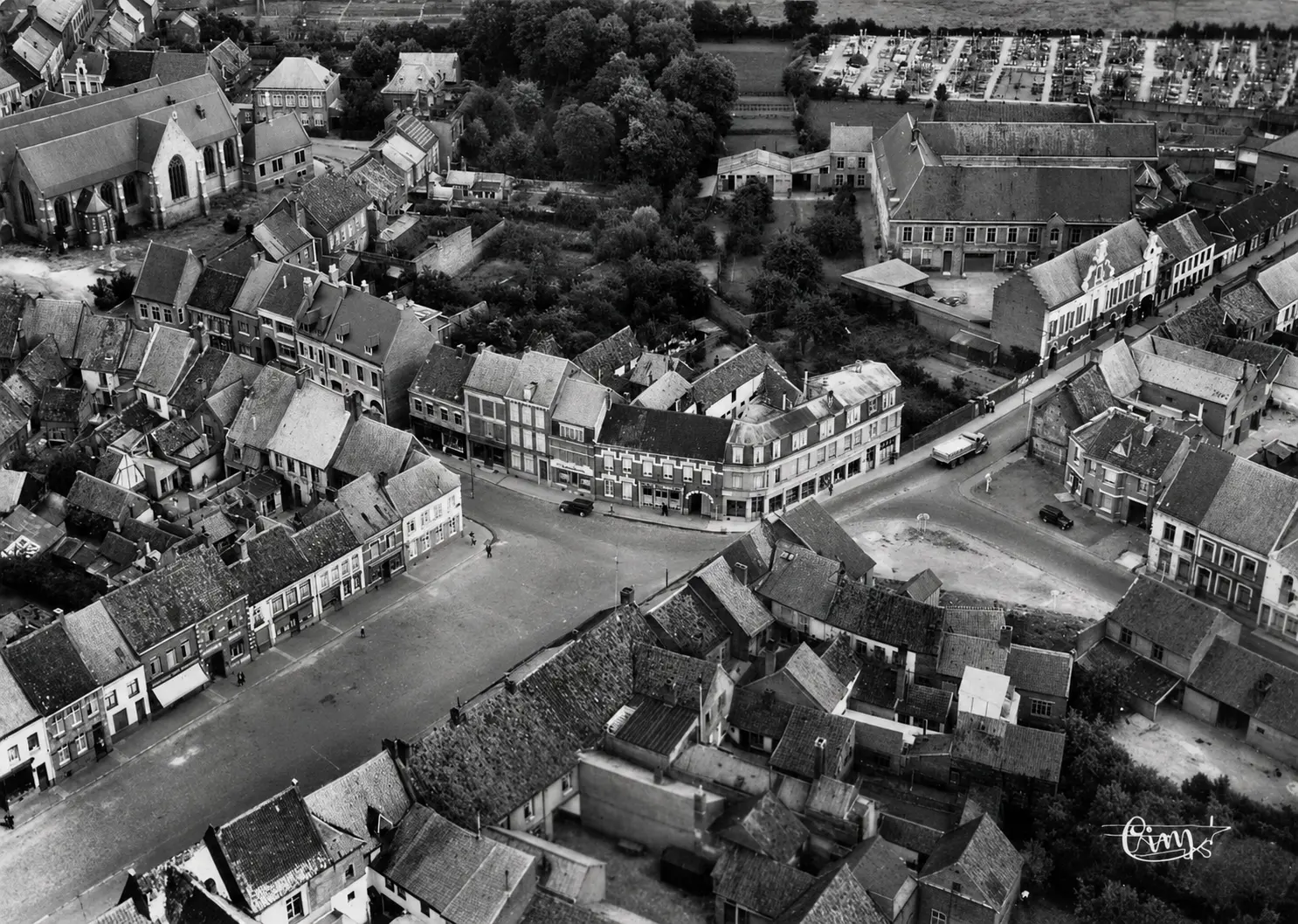
Aerial view of Steenvoorde circa 1954–1955. St Peter’s Church, rebuilt after the Second World War, dominates the centre of the town. The empty spaces between the Grand-Place, Rue Carnot and Rue de Poperinghe are likely a reminder of the destruction caused by the bombing. This area also corresponds to the old cobbled path that allowed people to cross the Ey Becque, which was the catalyst for Steenvoorde’s development. The Hospice des Sept-Fontaines and the Town Hall are visible in the top right-hand corner.
The Renaissance and the Modern Era
This period marked a major turning point in the history of Steenvoorde. The town enjoyed significant cultural influence thanks to the chambers of rhetoric, but it was also deeply affected by the Wars of Religion, the iconoclastic furore and the conflicts between France, Spain and the United Provinces. Despite these trials, Steenvoorde retained an important role at the heart of Flanders and was definitively incorporated into the Kingdom of France in 1678.
The Chamber of Rhetoric and Steenvoorde’s cultural vitality
On 6 November 1518, the sovereign chamber De Fonteine of Ghent issued a charter of recognition to the Steenvoorde chamber of rhetoric, whose Flemish motto was Ontsluyters van Vreughden (Dispensers of Joy). These literary and theatrical societies, known as rederijkerskamers, were the driving force behind cultural life in the towns of the former Netherlands at the time, organising poetry competitions and theatrical performances. The Steenvoorde chamber played an active role in this movement: it took part in the competitions at Nieuwpoort in 1520 and 1540, hosted a competition in Steenvoorde in 1531 and participated in the competition at Diksmuide in 1560, bearing witness to the town’s cultural vitality throughout the 16th century.
1553-1678 - From the destruction of Steenvoorde to its annexation by France
The 16th and 17th centuries were a particularly turbulent period for Steenvoorde. In 1553, during the wars between the Kingdom of France and Emperor Charles V, the village was burned and destroyed by imperial troops. This destruction left a lasting mark on the town's history and ushered in a long period of reconstruction.
On 10 August 1566, the Saint Lawrence Monastery became the first place of worship affected by the Iconoclastic Fury (Beeldenstorm). Following a Protestant sermon, statues, religious images and liturgical objects were destroyed. This event sparked a movement that quickly spread throughout the Spanish Netherlands and marked the beginning of the revolt against Spanish rule. A commemorative monument, inaugurated in 2016 on the occasion of the 450th anniversary of the event, now recalls this major episode in European history.
In 1567, the Duke of Alba established the Council of Troubles to repress those responsible for the Iconoclastic Fury. In Steenvoorde, sixteen inhabitants were sentenced in absentia to exile and confiscation of their property, illustrating the severity of the Spanish repression.
During the following decades, Steenvoorde suffered the consequences of the conflicts between Spain, France and the Dutch Republic. Despite destruction and economic hardship, the town gradually recovered. Following the Treaties of Nijmegen (1678), Steenvoorde was permanently incorporated into the Kingdom of France.
1621 – The Alliance of the Houses of La Viefville and Mérode
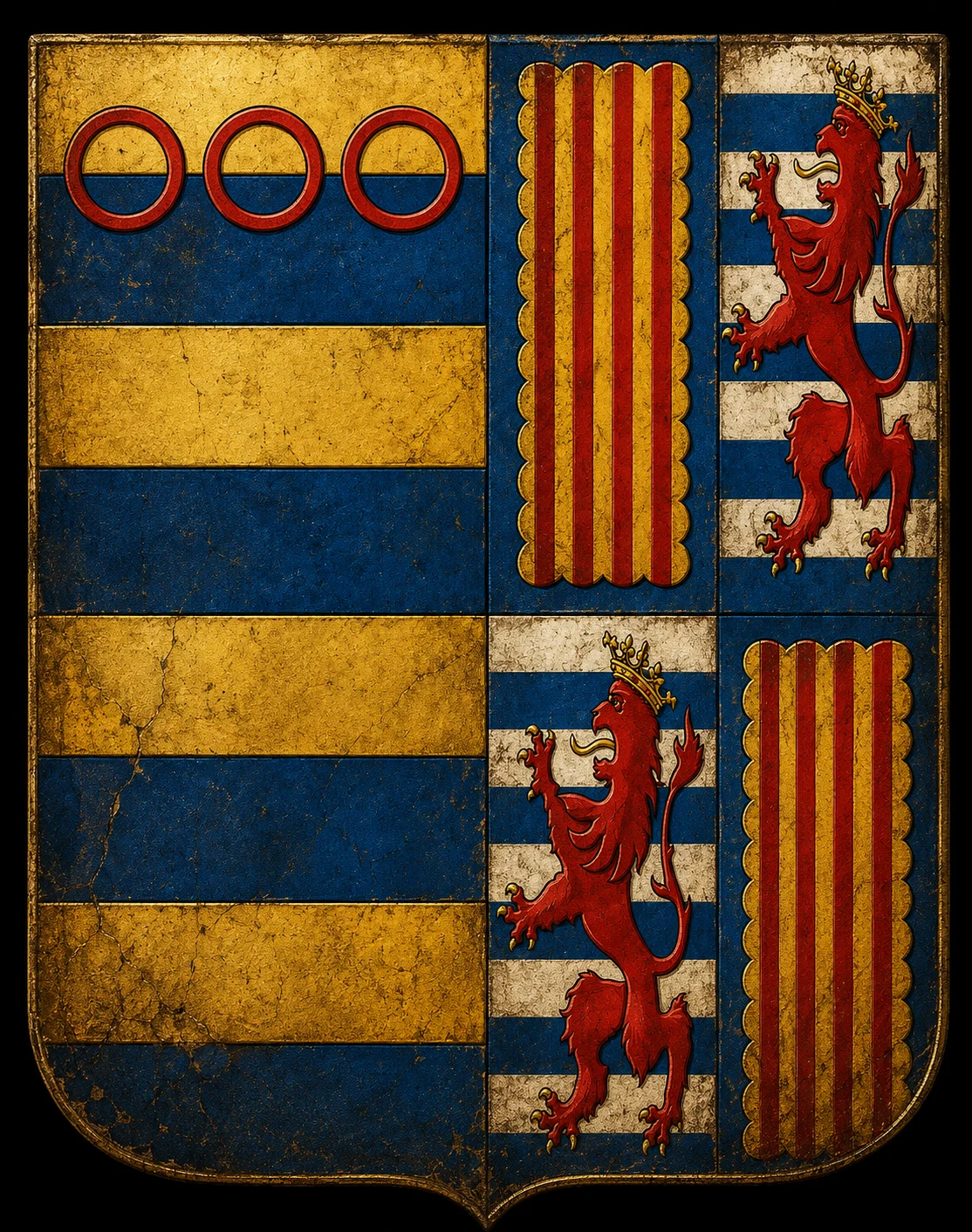
In July 1621, Eustache-Pantaléon de La Viefville, Baron and Lord of Steenvoorde, married Claudine de Mérode at the Church of Our Lady of the Chapel in Brussels. This alliance between the Houses of La Viefville and Mérode formed part of the network of kinship linking the leading noble families of the former Low Countries. On this occasion, the combined coats of arms of both families symbolised their union. Under the authority of Eustache-Pantaléon, the lordship continued its reconstruction following the wars of the sixteenth century. The arms of the House of La Viefville, combined with those of Claudine de Mérode, still bear witness today to the prestige and influence exercised by these two noble lineages in the history of Steenvoorde.
1711 – Steenvoorde Becomes a Marquisate
In 1711, by Letters Patent issued by Louis XIV, the Lordship of Steenvoorde was elevated to the rank of a marquisate in favour of François-Joseph-Germain de La Viefville, in recognition of the antiquity of his house and the services rendered by his family to the sovereigns of the Spanish Netherlands and later to the Kingdom of France. The new marquisate united the estates of Steenvoorde, Oudenhove and Ochtezeele, confirming the status of the La Viefville family among the leading noble lineages of Flanders. This elevation marked the height of their influence over the lordship, which they administered until the French Revolution.
The French Revolution in Steenvoorde
The French Revolution caused deep divisions amongst the local population. In 1791, whilst a ‘Club of Friends of the Public Good’ inspired by the Jacobins was established in the town, the parish priest rejected the Civil Constitution of the Clergy and remained loyal to the Bishop of Ypres. Three years later, on 23 April 1794, the Marquis Louis-Auguste de La Viefville, the last lord of Steenvoorde, was guillotined in Arras along with his daughter and his laundress in the famous ‘royalist parrot’ affair. This episode remains one of the symbols of the excesses of the Reign of Terror in the Nord
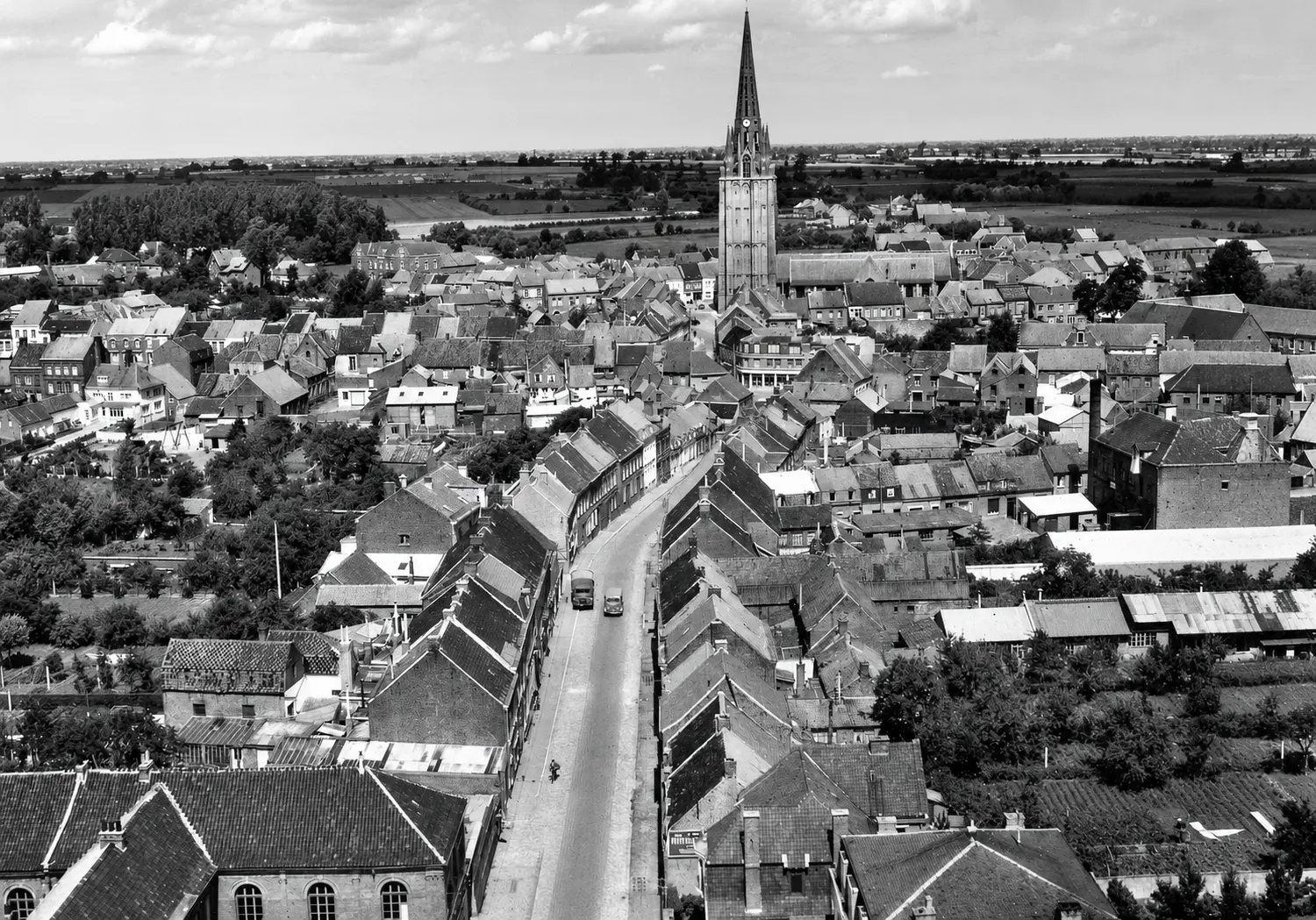
Aerial photograph of Steenvoorde taken in the early 1960s. The view shows Rue Carnot leading towards Saint-Pierre Church, in the heart of the village. This image illustrates the layout of the village centre prior to the major urban developments of the second half of the 20th century.
The historical heritage of Steenvoorde
Over the centuries, Steenvoorde has accumulated an architectural and cultural heritage that bears witness to its history. The church, mills, railway line and economic activities illustrate the town’s development, from medieval Flanders to the present day. Even today, these iconic sites contribute to Steenvoorde’s identity and appeal.
St Peter’s Church: a testament to past prosperity
Built on the site of an earlier place of worship, whose origins probably date back to the 11th and 12th centuries, as evidenced by several sandstone blocks still visible in its foundations, Saint Peter's Church was rebuilt and enlarged in the Gothic style between the 15th and early 16th centuries, reflecting the former prosperity of Steenvoorde.
On 15 August 1566, the church was devastated during the Iconoclastic Fury. Following the fire of 1583, in the midst of the Eighty Years' War, a first restoration campaign was undertaken. Financed in part by a tax on beer and wine, the works were completed in 1600. This date, still visible on the gable of the left aisle, commemorates that first restoration. The church suffered further damage in 1644 during the Franco-Spanish War before reconstruction was finally completed in 1664. The black marble baptismal font, dated 1658, bears witness to this period of renewal.
Damaged by a violent storm in 1809, the church was restored at the end of the 19th century. A new spire was erected in 1891. Severely damaged during the bombing raids of May 1940, it was restored after the Second World War and reopened for worship in 1950.
Today, Saint Peter's Church is the principal monument of Steenvoorde. Dominating the landscape of French Flanders, its 92-metre bell tower, crowned by the spire erected in 1891, can be seen from several kilometres away and remains one of the area's most remarkable landmarks. It occupies a central place in the municipality's heritage and identity.
The mills and the Flemish rural economy
For centuries, Steenvoorde’s economy relied primarily on agriculture. Mills played a vital role in processing the grain produced in the surrounding countryside. The Noordmeulen, first recorded in the 16th century, contributed to the agricultural vitality of inland Flanders for several generations. The Drievenmeulen, meanwhile, was built in Somain in 1776 as an oil mill before being dismantled and reassembled in Steenvoorde in 1901, where it was converted into a flour mill. In the 20th century, industrialisation led to the gradual decline of traditional milling. The Noordmeulen ceased commercial operations in 1954, whilst the Drievenmeulen was gradually repurposed for heritage purposes. Now preserved, these two mills remain major symbols of Steenvoorde’s rural heritage.
1806 – Foundation of the Steenvoorde Band
The Steenvoorde Band was founded in 1806 by former military musicians at the beginning of the First French Empire. In 1820, it became the National Guard Band, marking the beginning of its official organisation.
1860 – Establishment of the Savings Bank
On 6 July 1860, an imperial decree issued by Napoleon III authorised the establishment of the Steenvoorde Savings Bank. This decision formed part of the expansion of savings banks during the Second French Empire and reflects the administrative and commercial importance of the town during the nineteenth century.
The arrival of the railway
The former Steenvoorde station, the local terminus of the ‘Petit Train des Flandres’. Opened alongside the Hazebrouck–Hondschoote line in 1894, it contributed to the town’s economic development for nearly sixty years by facilitating travel for residents and the transport of agricultural produce, before the line closed in 1954.
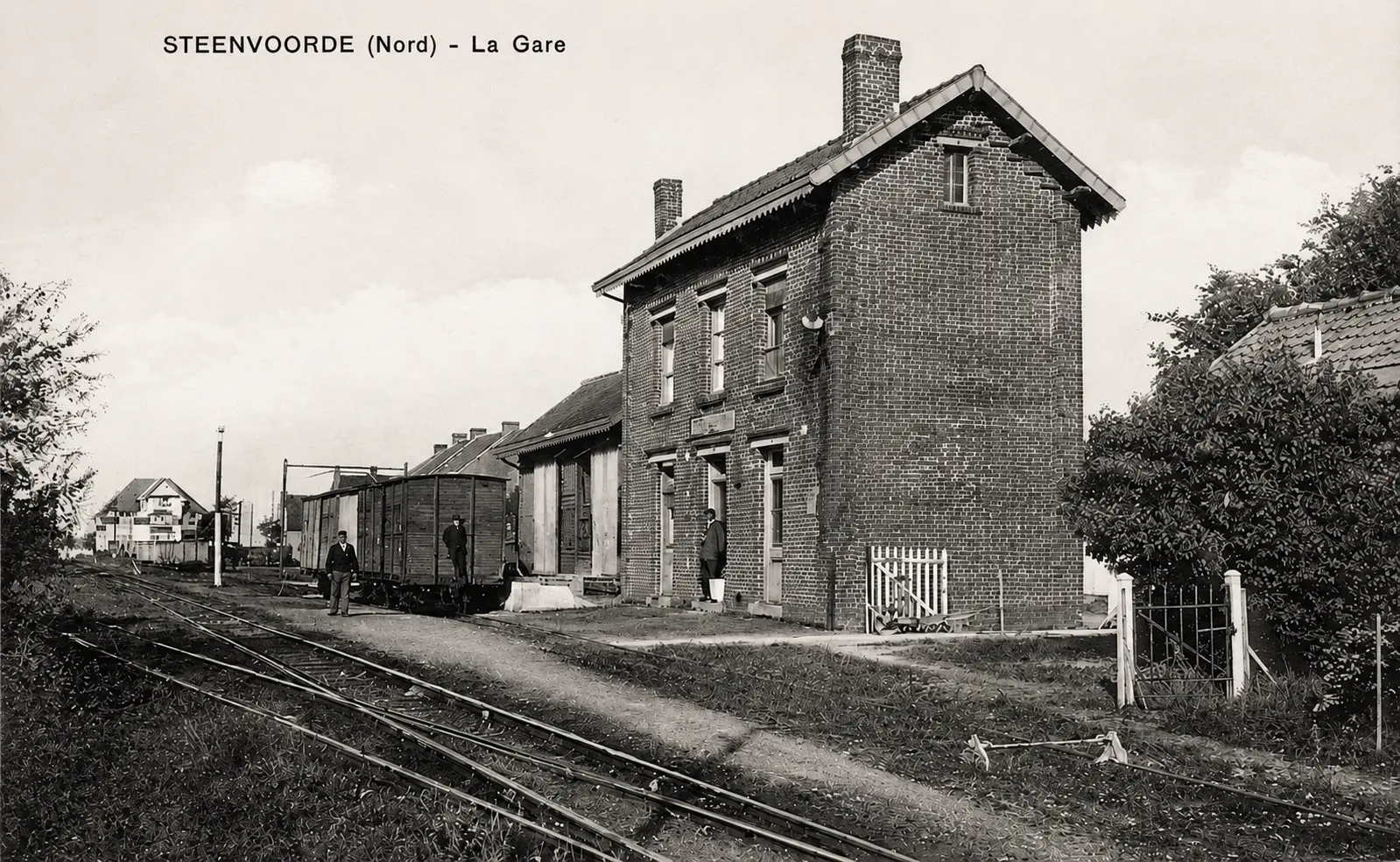
In 1894, Steenvoorde was served by the Hazebrouck–Hondschoote local railway line, the construction of which had been approved by the Nord Departmental Council in 1891 in order to open up the rural communities of Flanders. This new link strengthened Steenvoorde’s role as the central market town of the Inner Flanders region, facilitating trade with markets, stations on the national network and neighbouring towns. Operated by the Flanders Railway Company and nicknamed the ‘Little Train of Flanders’, this metre-gauge line facilitated travel for local residents and the transport of agricultural produce, notably cereals, hops and beetroot, thereby contributing to the town’s economic development. After the Second World War, the widespread adoption of the car and road transport led to its decline. Having become unprofitable, the line was permanently closed in 1954. The former station, situated on Place Jean-Marie-Ryckewaert, remains today a reminder of this railway era.
Economic development in the 19th and 20th centuries
Fairs, agriculture and economic growth
From the 19th century onwards, Steenvoorde underwent a significant period of modernisation. This period built on a long-standing tradition of fairs and markets in Steenvoorde. In 1671, King Charles II of Spain granted the lordship of Steenvoorde the right to hold two free fairs, in May and October. In the 19th century, the livestock fairs, held during the first week of every month from April to November, became important events for livestock farmers, traders and residents of neighbouring towns.
On 4 July 1891, on the initiative of Alphonse Outters, then mayor of Steenvoorde, the local councils and leading farmers of the canton established the Agricultural Society. Its aim was to defend the interests of the rural community, encourage improvements in farming practices, and organise competitions, animal shows and fairs.
In particular, the Comice played a key role in organising the May agricultural fair, the successor to the old livestock fairs. Over time, this event became one of the highlights of life in Steenvoorde. It continues today under the name Mei-Feest, one of the town’s most iconic events, keeping alive Steenvoorde’s agricultural, commercial and festive traditions.
Breweries, hop processing, shoe workshops and agricultural processing businesses all contribute to job creation and local economic growth. Agricultural produce, notably cereals, hops, beetroot and livestock, supplies the markets and supports craft industries. The footwear industry left a particularly significant mark on Steenvoorde’s history before the closure of the last local factory in 1964.
During the 20th century, Steenvoorde saw the development of new industrial activities. Founded in 1911 under the name ‘Les Fermiers Réunis des Flandres’, the local dairy became a major player in dairy processing and continues to operate today as part of the Danone group. Since 1978, the town has also been associated with medical research and biological diagnostics. Building on the work of the Pasteur Institute in Lille and integrated into Bio-Rad in 1999, the Steenvoorde site contributes to the region’s scientific and economic influence.
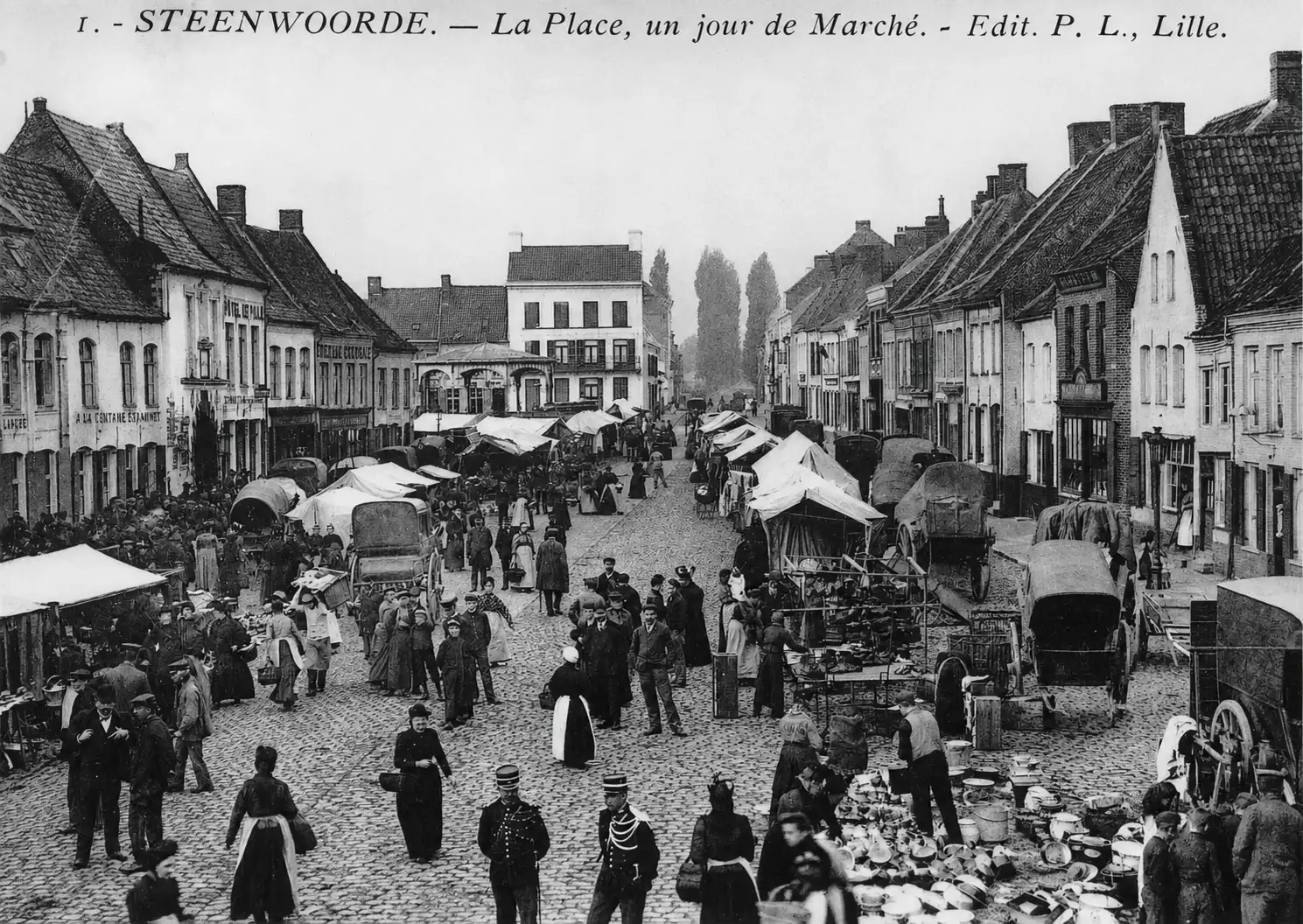
The Grand-Place in Steenvoorde on market day, in the early 20th century. This old postcard illustrates the bustling trade that made Steenvoorde an important market town in French Flanders. Farmers, craftspeople, traders and local residents would gather there every week around stalls and carts laden with local produce, making the market a vital hub for trade and social interaction. A true testament to Steenvoorde’s heritage, this scene reflects the daily life and economic vitality of the town before the rise of modern transport.
1901-1903 – The Alphonse Outters Affair
In the early 20th century, Steenvoorde was rocked by one of the most significant political and financial scandals in its history. The scandal caused by its mayor, Alphonse Outters, made national headlines and left a lasting mark on local memory.
Mayor of Steenvoorde since 1884, a notary and former Member of Parliament, Alphonse Outters had for years been concealing fraudulent financial dealings: by drawing on his clients’ assets using forged documents to speculate on the Paris Stock Exchange, he accumulated debts exceeding two million gold francs. On 7 July 1901, he disappeared. In the civil registry records, his deputy, Charles Mortier, crossed out the five words that had become null and void – ‘Auguste, Henri, Alphonse Outters, mayor’ – and signed in his place. Sentenced in absentia to life imprisonment with hard labour in 1903, he took refuge in Florence and never returned to Steenvoorde.
1914–1945 – The Two World Wars
The two world wars left a deep mark on Steenvoorde and its people. Although situated some distance from the main battlefields, the town played its part in the war effort, enduring bombing raids, the German occupation and the fighting during the Liberation. Today, several monuments and memorial sites still bear witness to this history.
1913 – The Steenvoorde War Memorial
Located at the foot of Saint Peter's Church, the Steenvoorde War Memorial was inaugurated in 1913. It depicts a flag-bearing officer of the Mobile Guard, commonly known as a "moblot". It preserves the memory of the sons and daughters of Steenvoorde who died for France, from the campaigns of the Second Empire to the two World Wars. Standing in the heart of the village, it is one of the municipality's main places of remembrance and reflects the community's commitment to preserving the memory of those who made the ultimate sacrifice.
1914–1918 – The First World War
Situated behind the Flanders front, Steenvoorde played a supporting role during the First World War. The town hosted a rear command post responsible for organising the stationing of troops and military medical services. However, it was not spared by the conflict and came under bombardment from German artillery. As a testament to this period, the seven graves of British soldiers in the municipal cemetery serve today as a reminder of the impact of the Great War on the area.
1939–1945 – The Second World War and the Liberation
The Second World War proved yet another ordeal for the population. Like the rest of the country, Steenvoorde was under German occupation for four years.
In May 1940, during the German offensive, Steenvoorde came under several bombardments which caused extensive destruction in the town centre. Several buildings were damaged or destroyed.
On 4 September 1944, a shooting at a place known as Le Boerenhol left five people dead (three Belgians and two residents of Steenvoorde) and several others wounded. Three residents of Steenvoorde were then taken to the town square to be shot. According to a 1945 eyewitness account, the German authorities also considered taking a hundred hostages and setting the town on fire.
The intervention of the mayor, Félix Delobeau, assisted by Jules Charleis and Jean Camerlynck, led to the release of those sentenced to death and the abandonment of the planned reprisals.
The three men were awarded the Medal for Courage and Devotion by decree dated 12 August 1945.
On 6 September 1944, the town was liberated by soldiers of General Stanisław Maczek’s 1st Polish Armoured Division. Following the fighting in Normandy, the Polish troops passed through Steenvoorde whilst pursuing the German army towards Belgium.
This liberation remains one of the most significant events in the town’s modern history and is still widely commemorated today. As a token of Steenvoorde’s gratitude to the Polish soldiers, lasting ties have been forged with Poland, leading to the signing, in 2017, of a twinning agreement with the town of Zbąszyń. This twinning stems from the shared history of the two towns and from the desire to keep alive the memory of the role played by the 1st Polish Armoured Division in the liberation of Steenvoorde in 1944.
1945–2000 – Steenvoorde in the Second Half of the 20th Century
Following the Liberation in 1944, Steenvoorde entered a period of modernisation and development. Agriculture became mechanised, economic activities evolved and new public facilities were built. Community life flourished with the growth of the Steenvoorde Sports Association, founded in 1941, the Tennis Club and, in the early 1970s, the AJL Judo club. In 1968, Valéry Giscard d’Estaing opened the Youth Centre, a symbol of the dynamism of Steenvoorde’s young people.
In 1965, the town was proclaimed the ‘Hop Capital’, giving new impetus to the Hop Festival. From the 1960s to the 1980s, this event established itself as one of the major festivals in Flanders. Parades, giant figures, a street market, entertainment and variety shows attracted large crowds every year. The appearance of numerous popular French singers helped to raise the event’s profile and boost Steenvoorde’s reputation. This period left a deep mark on the town’s contemporary history and bears witness to the vibrancy of its community, sporting and cultural life.
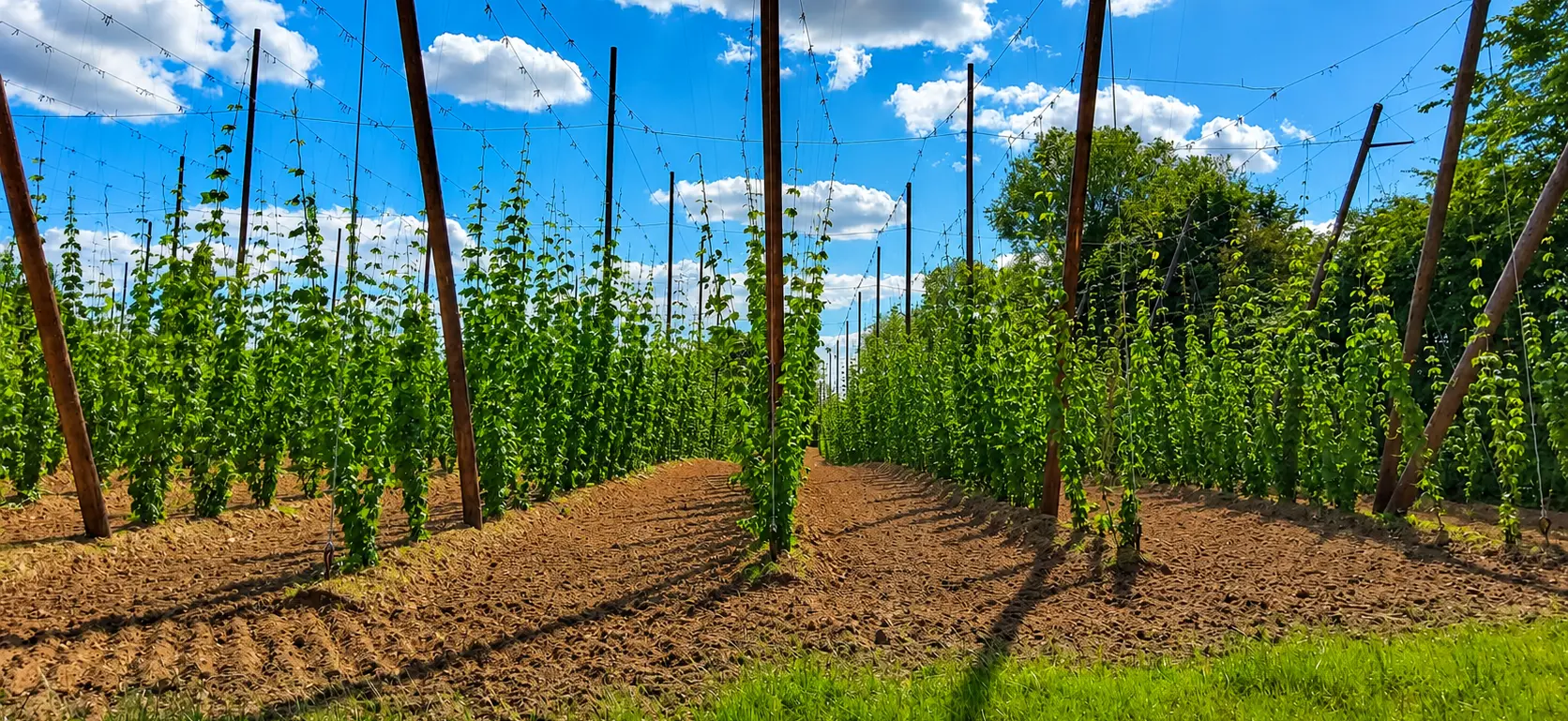
A thriving hop field, a symbol of the town’s agricultural and brewing heritage.
Notable figures who have put Steenvoorde on the map
In the 21st century, several prominent figures have helped to raise Steenvoorde’s profile far beyond the region of Basse-Flandre. The cyclist Cédric Vasseur is one of the town’s most iconic sportsmen. A professional from 1993 to 2007, he won two stages of the Tour de France, in 1997 and again in 2007. His greatest achievement came during the 1997 Tour de France when he won the stage at La Châtre following a long solo breakaway and claimed the yellow jersey, which he held for five days. Iris Mittenaere, who grew up and spent part of her school years in Steenvoorde, went on to become Miss France 2016 and then Miss Universe 2016, bringing international recognition to the town. Through their respective careers, these figures have helped to raise Steenvoorde’s profile both in France and abroad.
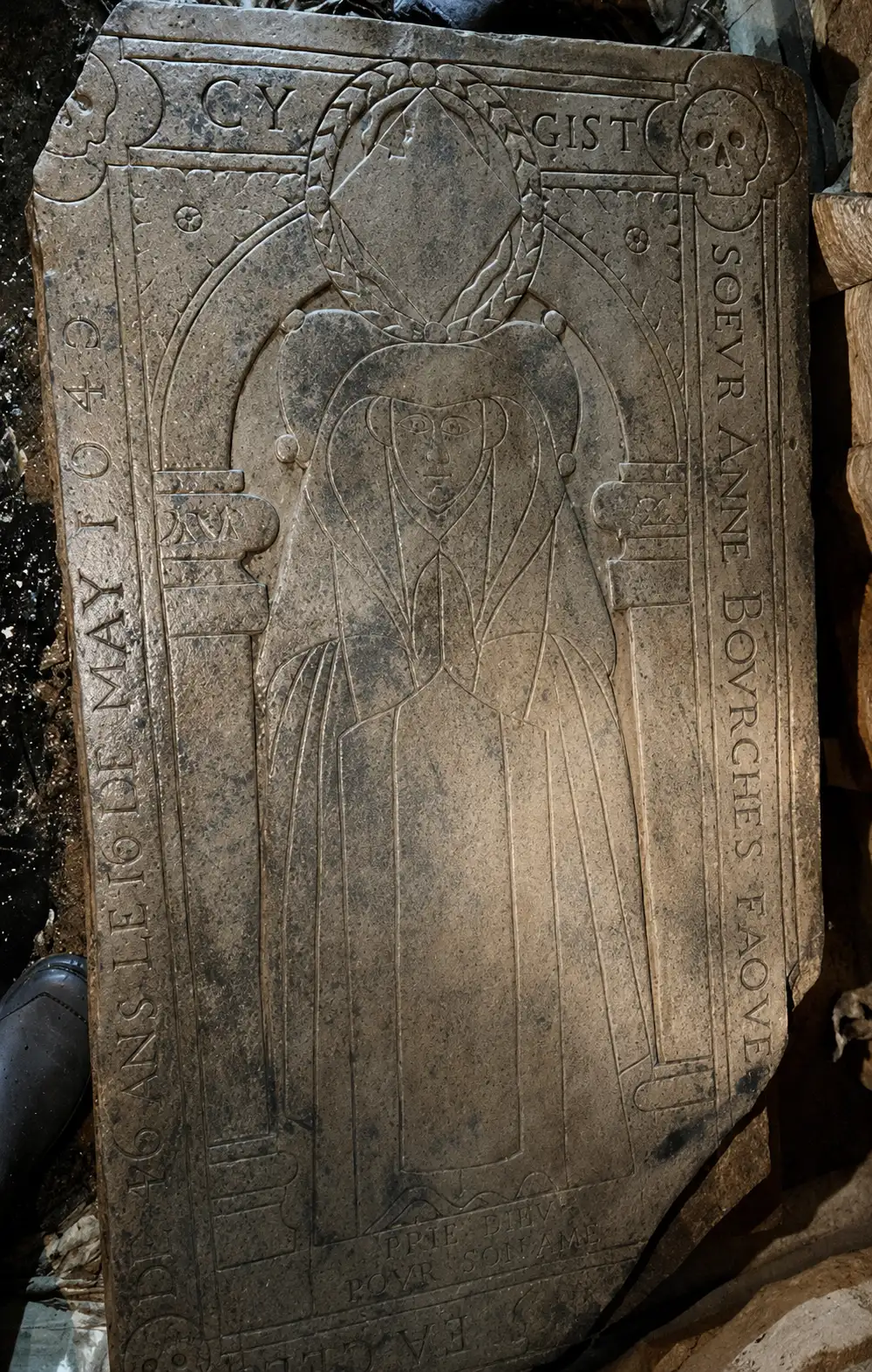
2023 – Rediscovery of Sister Anne's Funerary Slab
Sometimes, traces of the past reappear and shed new light on the history of our town, even when they were believed to have disappeared forever.
During the final demolition of the former Les Sept Fontaines nursing home in 2023, an exceptional piece of the town's history resurfaced. Several people had spoken of an old funerary slab hidden in the flooded cellars of the building, which had been constructed on the site of the former Notre-Dame des Sept Fontaines convent hospital.
Stored in the cellars during renovation work in the 1970s, the slab gradually fell into oblivion. After nearly one metre of water, mud and mineral deposits had been pumped out, the search finally proved successful. Beneath a thick layer of mud, this remarkable blue stone funerary slab, dated 1649, reappeared.
This funerary slab is probably the only surviving remains of the former Notre-Dame des Sept Fontaines convent hospital, founded in 1404 by Mathieu de Licques, Lord of Steenvoorde.
Steenvoorde today
Today, Steenvoorde harmoniously blends historical heritage, folk traditions and local vitality. With its Saint-Pierre church, mills, hamlets, Flemish landscapes, carnival, giant floats and the Hop Festival, the town remains one of the most iconic symbols of French Flanders. Discovering Steenvoorde means exploring over a thousand years of history at the heart of a region where heritage, memory and traditions continue to thrive in everyday life.
Also worth discovering
To extend your exploration, discover the Hamlets of Steenvoorde, the Giants ofSteenvoorde, the Steenvoorde Carnival, and Visit Steenvoorde and the Monts de Flandre. These pages will give you a better understanding of Steenvoorde’s heritage, traditions and identity at the heart of French Flanders.
Historical Milestones
Over the centuries, Steenvoorde successively belonged to the County of Flanders from the 9th century to 1384, the Burgundian Netherlands from 1384 to 1482, the Habsburg Netherlands from 1482 to 1556, and the Spanish Netherlands from 1556 to 1678. Permanently incorporated into the Kingdom of France by the Treaties of Nijmegen in 1678, the town has since shared the history of France while preserving its heritage, architecture, and identity, all deeply shaped by its Flemish roots.
For the medieval period, the principal references are the chronicle of Galbert of Bruges, De multro, traditione et occisione gloriosi Karoli comitis Flandriarum (1127–1128), together with the chronicles of William the Breton (Philippide), Rigord (Gesta Philippi Augusti) and the Annales Gandenses for the campaign of 1214. Cartularies and comital charters preserved in the General State Archives of Belgium and the Departmental Archives of Nord (Series B) document the earliest references to Steenvoorde, its lords and its belonging to the County of Flanders.
The history of the Sept-Fontaines Convent and Hospital is based in particular on Collection 52 H of the Departmental Archives of Nord and on the Bulletin du Comité flamand de France (Vol. XIII, 1875–1877). The chamber of rhetoric Ontsluyters van Vreughden is attested by the charter of recognition issued by De Fonteine of Ghent on 6 November 1518. The events of 1553, the Iconoclastic Fury (Beeldenstorm) of 1566, and the repression of 1567 are documented through the archives of the Castellany of Cassel, the chronicle of Marcus van Vaernewijck, Van die beroerlicke tijden in die Nederlanden, and the archives of the Council of Troubles, preserved in the General State Archives of Belgium.
The history of the Lordship of Steenvoorde during the 17th and 18th centuries is based on the parish registers of Notre-Dame-de-la-Chapelle in Brussels, the archives of the La Viefville and de Mérode families, the letters patent issued by Louis XIV raising the lordship to a marquisate in 1711, contemporary armorials and proofs of nobility, and the genealogical works of Félix-Victor Goethals, La Chesnaye-Desbois, and the Annuaire de la noblesse de Belgique.
For the modern and contemporary periods, the Departmental Archives of Nord (Series B, E, H, M and U), the Departmental Archives of Pas-de-Calais, municipal archives, the proceedings of the General Council of Nord, decrees published in the Bulletin des lois, the archives of the Compagnie des chemins de fer des Flandres, the Steenvoorde Philharmonic Society, the Comice agricole, the Fermiers Réunis des Flandres dairy (now Danone), Bio-Rad, and historical and contemporary newspapers constitute the principal sources for the commune's administrative, economic, industrial and associative history.
Protected monuments and objects are documented in the Mérimée and Palissy databases of the French Ministry of Culture. Military graves are recorded by the Commonwealth War Graves Commission. Military operations during both World Wars are documented through the collections of the Service historique de la Défense and the archives of the 1st Polish Armoured Division. Information relating to the Tour de France is based on the race's official archives and the collections of the INA. The biographical information concerning Iris Mittenaere, together with the commune's industrial history, is also based on regional and national newspapers and on institutional publications issued by the organisations concerned.

A website dedicated to the Giants of Steenvoorde, their history, their associations and the Summer Carnival.
© 2023 / 2026 – Steenvoorde and its Giants
Legal notices: Website hosted by planethoster.fr
Design: Pascal Cnockaert
Documentation and archives
The information presented on this website is based on public archives, historical publications, press articles, photographic collections, oral accounts and heritage resources relating to the history of Steenvoorde, its giants and its carnival.
Traduction automatique Deepl