
Jean the Woodcutter, Steenvoorde’s legendary hero
An iconic figure in Steenvoorde’s folklore, Jean the Woodcutter embodies the strength, courage and spirit of solidarity that characterise Flemish traditions. According to legend, this craftsman of exceptional stature took up arms to defend Steinfort against Norman invasions, thus becoming the protector of an entire community.
The Legend of the Giant Jean the Woodcutter of Steenvoorde
In those days, the market town of Steinfort was by no means a place of great splendour. Counts, barons, knights and feudal lords waged war far away, whilst the town’s inhabitants toiled hard and steadfastly.
The weavers diligently spun hemp whilst the cobblers courageously hammered leather, and the woodcutters of the Beauvoorde woods toiled with their axes or hatchets to fell the timber destined to ‘frame’ the heavy windmills; or else they hewed the logs intended for the immense fires in the fireplaces, for coal had never been used in these regions.
Flemish historians assert that in the Lordship of ‘Steinfort’, which at that time fell under the famous Castellany of Cassel, stood, two arrow-shots from the manor and on the woodland side, a modest farmstead straddling the river ‘Ey Beck’.
There lived, from father to son, the family of Jan de Steinfort, whose men were all tradesmen: skilled hemp spinners, hardy woodcutters or deft shoemakers.
Father Jan possessed his ancestors’ qualities to the highest degree, and for twenty leagues round there was no better craftsman than he, equally expert in the art of handling the shuttle, or ‘wevers-spoel’, as in the woodcutter’s axe, or ‘kapmes’, or even the simple flat hammer of the cobbler.
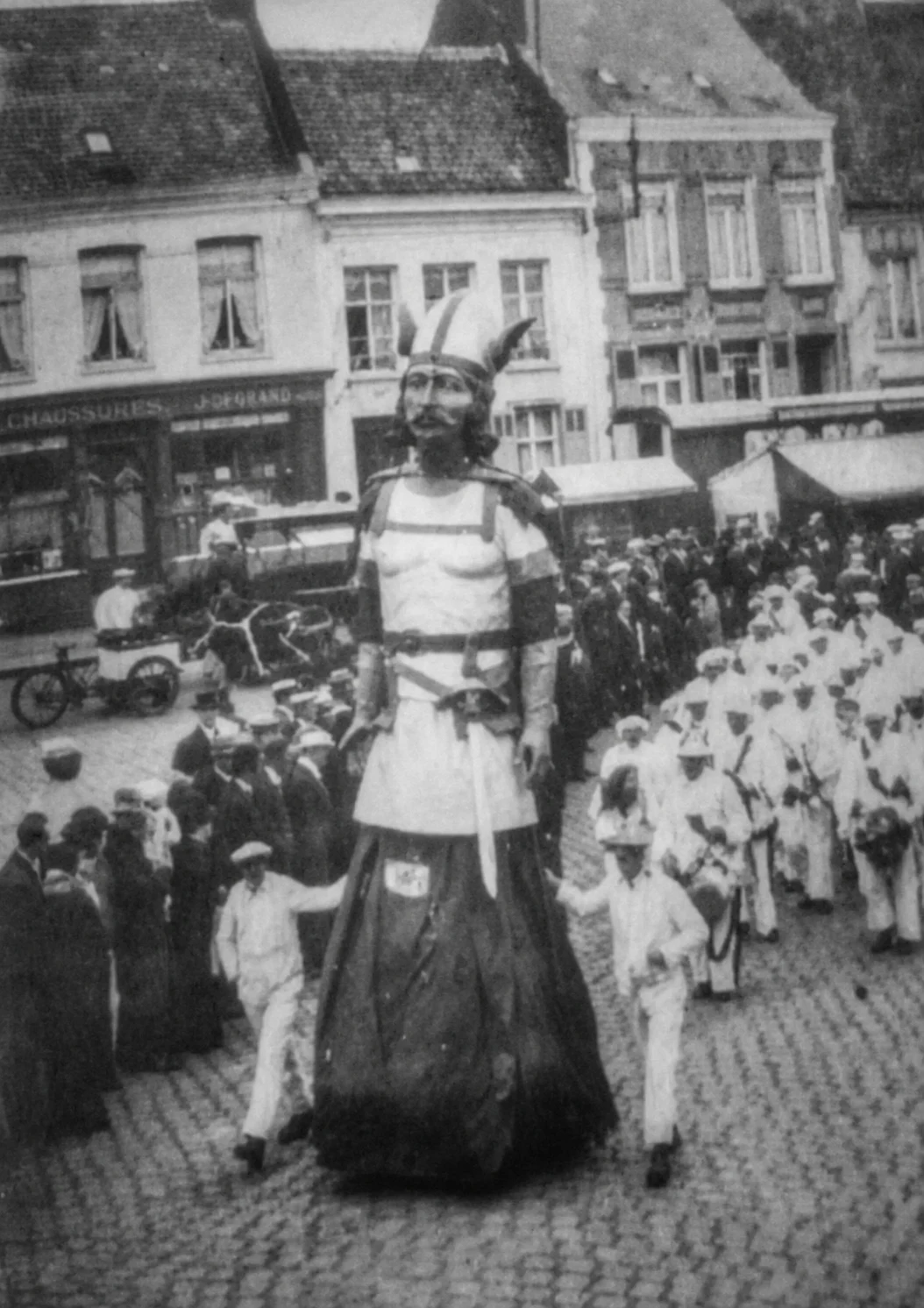
Jean the Woodcutter the First
He was known by the names "Jan de Wever", "Jan de Houthakker" or "Jan de Schoenmaker" in equal measure. He was a strapping fellow of gigantic stature and Herculean strength. Strength, moreover, ran in the family; but Jan in particular enjoyed an extraordinary reputation, a reputation of which he cared little, however, for the Flemish craftsman was never guilty of pride.
With feet planted firmly like the sturdy oaks of his homeland, a well-built torso and legs, arms like young saplings, a chest as broad as the table in the guardhouse of the stately castle, a fine Flemish face with blue eyes and blond hair that fell to his shoulders—such was our friend “Jan”; who was not at all put off, when Jacques Lauwaert, the village brewer, invited him to do so, from taking a barrel of “Oudebier” under each arm, which he would carry down the wide marble staircase into the vast cellars of the manor when the Lord of “Steinfort”, Thibaut the Bold, had distinguished guests at his table; great hunters and fine gourmets, who had come to the land of “l’Out-Land” to hunt fox, wolf, wild boar or deer.
Jan’s family seemed well-off, and because he and his kin knew and practised three trades, there was never any shortage of work. For over twenty years, Jan had even been the official shoemaker to the Emperor of the Franks, Carolus Magnus. Now it is known that Charlemagne, the glorious son of Princess ‘Berthe of the Big Feet’, had imposed the length of his boots as the standard of measurement throughout the vast empire under his rule, and that he had feet that were difficult to fit with shoes.
It is also known that the Great Emperor, drawn by the reputation for skill of the Flemish cobbler famous throughout Neustria, had passed through Steinfort on his way to campaign in Saxony. Saint Crépin’s disciple had provided the Emperor with a pair of shoes so sturdy, so well-made, and so well-preserved that this pair of shoes was still in use four years later when the Emperor set off for Spain to fight the pagans and the Muslims.
As a token of his gratitude, Charlemagne had sent his nephew Roland to present the famous Flemish shoemaker with a magnificent coat of mail or metal breastplate, a steel helmet, and a sword of the finest temper. The breastplate had the circumference of the pointed tower of the chapel at Steinfort Manor; as for the helmet, it could have served as a bathtub for Sir Thibaut’s young son. The sword, a true marvel of art, measured nearly five cubits and was as wide as two hands.
Jan hung the whole lot in the hearth of his father’s farmstead.
Now, a few years later, there was great sorrow in the land of the Flemings due to the death of the Great Emperor Charles, and shortly afterwards a terrified band of clerics and laymen, men and women, old people and children, was seen emerging along the road to Castrum (now Caëstre), dragging behind them pack animals and provisions on carts. From this crowd descending upon the town, a terrifying piece of news soon became known, namely that the ‘Noordmans’ (men of the North) were advancing, pillaging everything in their path. These “Noordmans” (or Normans) had sailed up the Seine as far as Lutetia with a large fleet, and a band of several thousand had reached the towns of Neustria. They planned to return via the North Sea, vowing to lay waste to everything in their path.
So the people of the village of Steinfort realised that their hour was near; they commended themselves to God, set about doing penance, and disposed of their worldly goods for the salvation of their souls. Reliable chroniclers tell us that there was not a single inhabitant in the village of Steinfort who was not overcome by fear and who was unwilling to give a single tournois or even a red liard, rightly believing, he said, that his ‘Flemish honour’, his ‘dignity as a craftsman’, and his status as a “loyal subject” did not permit him to show himself so cowardly; for our brave Jan recalled the words of the “Great Emperor” which his nephew Roland had reported to him twenty years earlier when presenting him with the coat of mail, the helmet and the sword, which are no adornment for commoners.
Meanwhile, “Jan Van Steinfort” and his two sons, Gilles and Jacobus, continued to strike repeated blows upon the tough Flemish leather, blows so harsh and violent that over there on the slopes of Mont Cassel the echo was roused and would reverberate against the flanks of the Cast-Berg, Jan, spitting into his right hand to ease the hammer’s swing, said to his sons:
“Be brave, lads! On Saturday, God willing, we’ll drain a barrel of beer at Siska’s, the good landlady of the Boernholl, to the health of those damned Normans who’ll never dare to approach Steinfort.”
The prior of Saint-Laurent Priory, the pious Abbot Jérôme, had decided to pay a visit to the cobbler’s family, who continued to work undisturbed but who, since the Sunday after vespers, had not set foot in the chapel, whilst the entire population had taken refuge in the churches and was praying fervently.
Half fearful, half trembling, the good abbot had entered the homestead through the great door, whose jambs were two oak trees, the two finest in the woods of Beauvoorde, felled by the very hand of Jan’s grandfather and carefully hewn.
“Father,” replied the cobbler, “we are good Christians, and I have vowed to Saint Peter the Great, the patron saint of the village, to Saint Lawrence, the protector of the priory, and to Saint Crépin, the patron saint of cobblers, that I shall never again drain a single barrel of beer unless, in the hour of danger, I am in the front line; and if, through my courage and that of my sons, I do not do my part to drive from our land the accursed pagans of whom you speak! Help yourself, and heaven will help you! There you have it, Reverend Father, my family’s motto. What is the point of worrying in advance? What use would it be to distribute the few possessions I have worked so hard to gather by the sweat of my brow and the strength of my arms, if tomorrow they are bound to fall, willingly or not, into the hands of these infidels?”
“That is well said, my son,” replied the prior, “and may the Lord grant your wish.”
The next day was Laetare Thursday, the mid-Lent day... The pale March sun rose slowly over the Flemish horizon, illuminating that vast plain of grey and gloomy hues that stretches between the municipality of Steinfort and the town of Cassel.
But this plain, ever so dreary, suddenly seems to come to life; from all sides, men-at-arms can be seen moving swiftly and resolutely; these were the Kings of the Sea, as the Normans called themselves, who, having bypassed the village from the road to Castrum, were now approaching via the road to Cassel, facing the portcullis that guarded the main entrance to Steinfort at a place known as ‘La Barrière’.
“La Gueularde”, the loudest bell of the manor chapel, rang out its most mournful notes across the Flemish plain.
“Jan van Steinfort”, who had risen before daybreak, knelt with his two sons and offered a prayer to Heaven...
"My sons! Let us leave the cobbler’s trade aside for now, for a better task calls us out; today we must see if Norman leather will yield easily to tanning."
Jan took down his breastplate and donned it, then placed the helmet adorned with a plume in the colours of the land upon his fair head. He kissed the hilt of his sword, which was shaped like a cross, but did not fasten it to his belt; having placed it upright at the edge of the alcove of the great bed where he rested each night, he said to his sons:
"God forbid that I should defile this holy sword with the blood of infidels. Besides, I know better how to wield the wrought-iron hammer and the polished steel kape-mes! May the great Saint Crépin, the good cobbler of the good Lord who throughout his life was a fine hammer-wielder, come to my aid, and grant me the courage to strike like him, hard and firm, in defence of our freedoms. You, my lads, follow me, and if, God forbid, I meet my death in battle, gather up my remains, carry them to the bed where my father died and where my grandfather gave up his soul to God, then call Father Jérôme to come and recite the prayers for the dead; after that, and before the Normans reach our estate, you shall build my coffin from ‘oak heartwood’ and lay it in the bed of the ‘Ey-Beck’, facing the land of the Franks, with the Great Emperor’s sword planted at my feet in place of a cross.”
In no time at all, Jan was at the gate... It was high time! The portcullis had already been forced open.
But then, in Steinfort, an unforgettable spectacle unfolded. Jan, who had a cobbler’s hammer at his belt and the sturdy long-handled ‘kape-mes’ in his rough hands, swung it in terrible circles, as never before had the mills of Cassel done in the fiercest of storms. Like ripe wheat bending before the advancing reaper, the Normans fell by thrust and cut, never to rise again. Down with the infidels! No quarter! Proud as the lion of Flanders, the cobbler shook his blond hair from time to time; he looked every inch the true baron, his courageous heart beating beneath his armour! And in the battle, our sturdy Flemish man fights fiercely.
“Help! Help!” cry the enemies, whilst others shout: “Let us flee as fast as we can!” And with that, a great many turn their backs. Jan shows no sign of tiring! He strikes on and on! He strikes down one after another! The road to Cassel clears, and through the Ryveld the pagans begin to flee in disarray! From the village, a few inhabitants had gone to the chapel to bring the great news. Little by little, all the people of Steinfort rush to the rescue, led by Jan’s two sons who charge at the bandits, following closely behind their father! Those from the neighbouring village of Winnezeele and Watou arrive next! So that by evening, the Normans—who had left the bodies of several hundred of their own to fertilise the Flemish plain—definitively retreat northwards. Night soon fell, and the successful pursuit completed the rout of the pagans, many of whom were drowned in the ‘rings slooten’ and in the salt lakes of the Moëres.
There was great joy at the Priory of Saint-Laurent, as at the Castle of Sir Thibaut, and in all the cottages of the weavers, woodcutters and cobblers of the town. Abbot Jérôme had the "Te Deum" sung, and Jan de Steinfort, with his two sons, took their places in the choir to thank the great Saint Peter, the courageous Saint Lawrence and the good Saint Crépin for their intervention, which had saved Steinfort from the horrors of pillage.
Jan, ever as modest as ever, returned to his father’s farmstead; he worked there for more than fifty years with the same courage, and every Laetare Thursday the magistrates of the good town of Steinfort would pay a visit to the famous cobbler.
Later, when Jan had passed away, the good people of Flanders erected a statue of the ‘Reuze van Steinfort’. The cobblers, weavers, woodcutters and all the other trades, led by the bailiffs, aldermen and other notable figures, paraded the Reuze from the La Barrière gate to the Bois de Beauvoorde, to the spot where Jan’s home once stood! However, the procession was brought forward by a few days and henceforth took place on Mid-Lent Sunday.
The guilds of Steenvoort preserved these traditions for a long time; they only disappeared after the horrors of the civil war. A few years later, the Friends of Fromulus revived this Flemish custom, much to the delight of all the inhabitants of Steenvoorde who cherished old memories.
Here ends the tale of the Giant of Steinfort.
To my friend César GILLOOTS
Founder and first president of the Society “Les Amis de Fromulus”
“Jan den Houtkapper, Reuze van Steinfort”
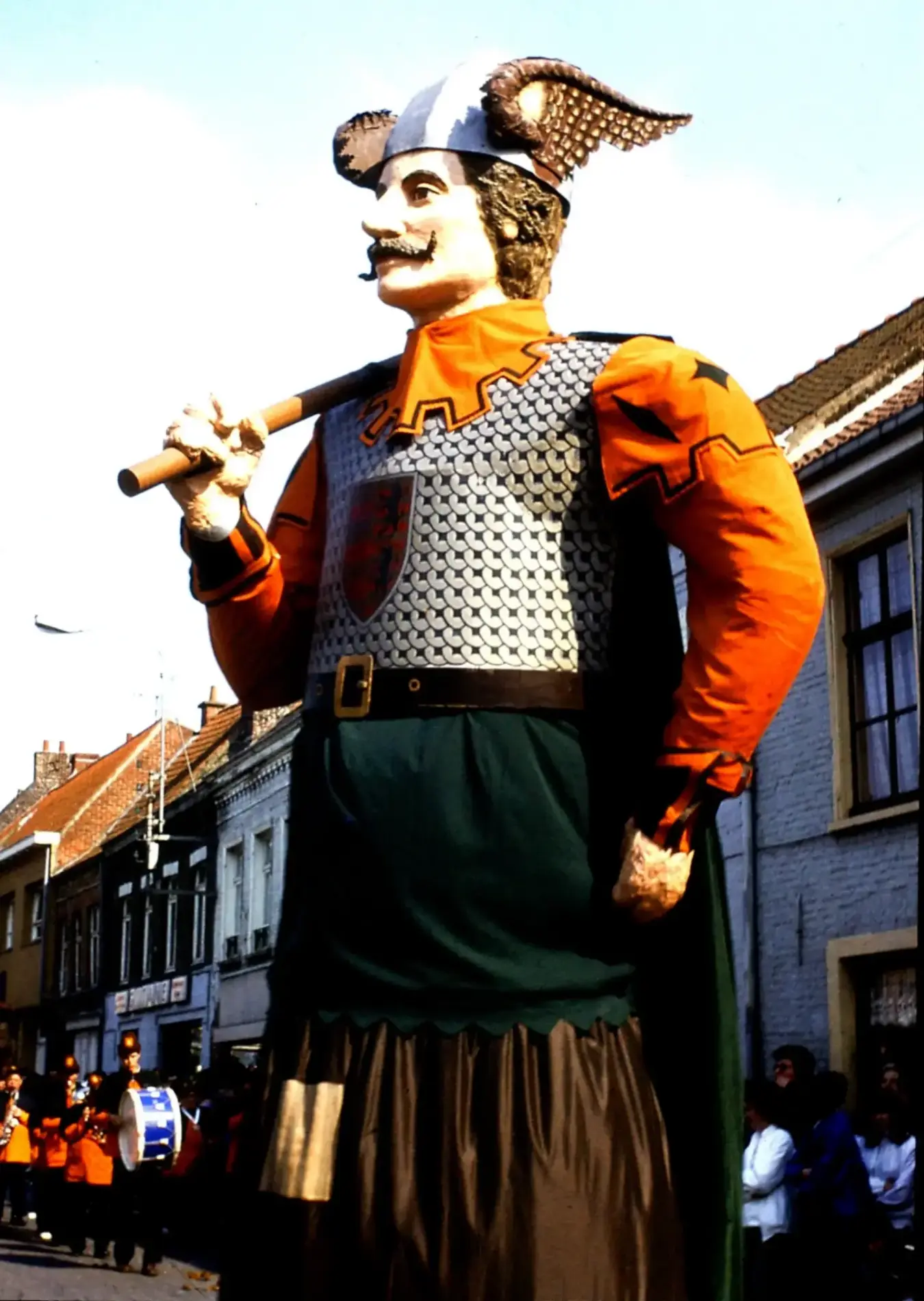
Jean the Woodcutter the 2nd - 1982

A website dedicated to the Giants of Steenvoorde, their history, their associations and the Summer Carnival.
© 2023 / 2026 – Steenvoorde and its Giants
Legal notices: Website hosted by planethoster.fr
Design: Pascal Cnockaert
Documentation and archives
The information presented on this website is based on public archives, historical publications, press articles, photographic collections, oral accounts and heritage resources relating to the history of Steenvoorde, its giants and its carnival.
Traduction automatique Deepl